
The blocky sun rose over Twinleaf Town, and for a moment the four green-roofed houses seemed to hold their breath. A player—call him the wanderer—stepped onto the main path, and the world of Minecraft did what it does best: it pretended to be somewhere else. This was Sinnoh, rebuilt block by block by Redditor bubsy200, and the tour moved with the quiet confidence of a fan who knows every bend in the road.
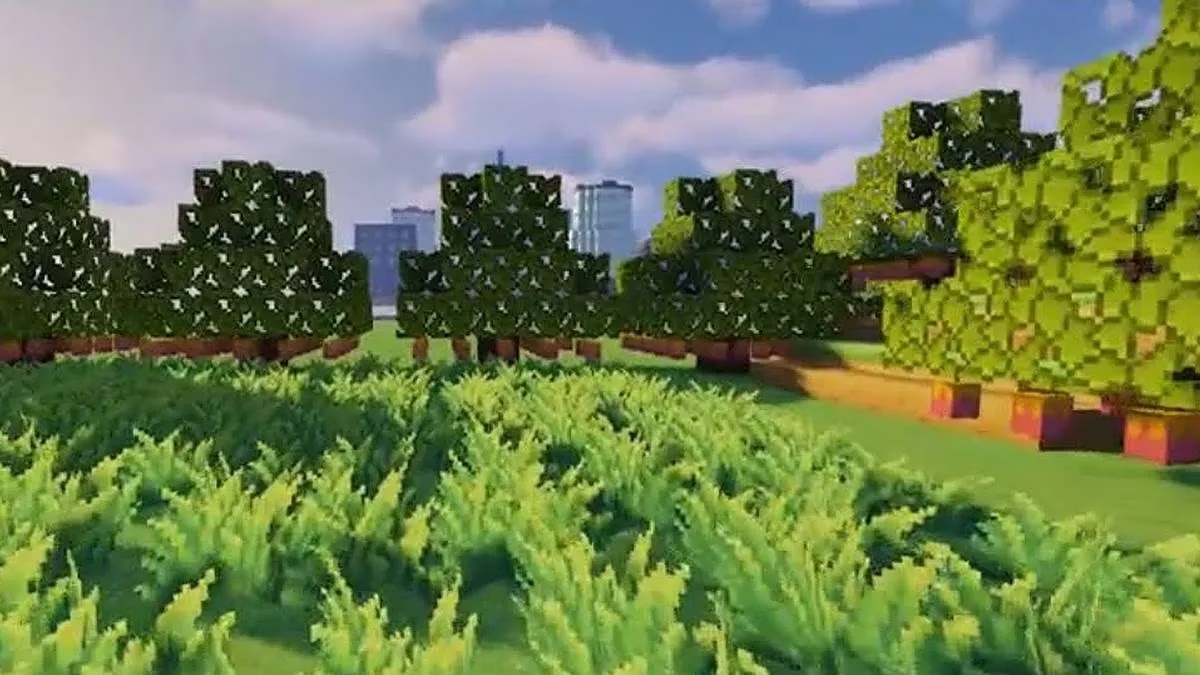
In the clip, Twinleaf Town is not a screenshot postcard. It is a place to walk through. Two Pokémon silhouettes wait near the path like shy neighbors, and the player passes them without a battle. Then the road opens into Route 201, the first wild area beyond home. In Pokémon Platinum, this is where Professor Rowan and Barry enter the story, where a first partner is chosen, and where the first battle begins. Here, the memory is rebuilt in grass and dirt blocks. Wild Ralts drift nearby—little green-and-white ghosts of encounter tables past. You know the feeling: the route is simple, but it hums with possibility. Honestly, that is the trick. The build does not need to be photorealistic to make a player remember. 🌱
Then comes Sandgem Town. The video shows a compact town with the places that matter: houses, a Pokémart, a Pokémon Center, Professor Rowan's research lab, and the assistant's house. The doors open. The player can step inside, which is no small feat in a game where many recreations stop at the facade. A town in Pokémon is a promise of routine—heal, shop, talk, move on—and this Minecraft version keeps that promise. The buildings are not hollow props; they are rooms with a job. 🏡
A small table can capture the tour:
| Stop | What the clip shows | Why it matters |
|---|---|---|
| Twinleaf Town | Four green-roofed houses, two Pokémon silhouettes | The quiet start, the first breath |
| Route 201 | Grass, paths, wild Ralts | The first step into the wild |
| Sandgem Town | Houses, Pokémart, Pokémon Center, Rowan's lab | The tutorial town made enterable |
| Route 202 | Wild Pokémon and trainer encounters | The road toward the first city |
| Jubilife City | A larger urban outline, still rough | A promise of more to come |
After Sandgem, the player pushes down Route 202, passing wild Pokémon and enemy trainers before reaching Jubilife City. The city is the one part of the tour that still feels like a sketch. Its buildings are not as fully fleshed out as Sandgem's, and the video does not pretend otherwise. But that is part of the charm. A work-in-progress world wears its seams openly. It says: come back later. There is more road ahead.
What lifts the clip above a simple showcase is the atmosphere. Pokémon music plays in the background. A texture pack softens the Minecraft edges into something closer to an old handheld screen. The result is not just a map; it is a mood. The trees along the route stand like patient guards, blocking certain paths and guiding the eye. The grass seems to wait for an encounter jingle. The whole world feels like an old Pokémon game that has learned to breathe in three dimensions. 🎮
By 2026, crossover builds have become a genre of their own. Players have rebuilt cities, islands, and entire regions, and Minecraft remains the favorite canvas because its open outdoor space resembles the picturesque routes of Pokémon. The Pixelmon mod proved how naturally the two worlds fit, turning Minecraft creatures into catchable partners and letting players train and battle. But hand-built regions like this Sinnoh tour do something different. They do not replace the rules; they rebuild the memory. They ask a simple question: can a place feel familiar before you even turn the corner?
The wanderer in the video keeps walking. Twinleaf gives way to Route 201, Sandgem gives way to Route 202, and Jubilife rises on the horizon. The tour ends before the whole region is finished, but that feels right. A region is not a weekend project. It is a long road, laid one block at a time. If bubsy200 continues, Sinnoh may one day be walkable from the first town to the last gym. Until then, the clip is a lovely little time capsule—part Minecraft, part Pokémon, and entirely built by a fan who wanted to go home again.
In-depth reporting is featured on Game Developer, whose coverage of level design, environment art, and fan-made reconstruction projects helps explain why a Minecraft take on Sinnoh feels so effective: the appeal is not just accuracy, but how spatial layout, traversal, and environmental cues recreate the emotional rhythm of exploring early Pokémon routes and towns.
Comments