
As a long-time Minecraft enthusiast, I'm constantly amazed by the boundless creativity and sheer scale of ambition within our community. Just when I think I've seen it all, a new project emerges that redefines the limits of what's possible within these digital blocks. The latest feat to capture my imagination? A stunningly detailed, one-to-one scale replica of New York City, shared by a user known as altmorty on the Minecraft subreddit. This isn't just a handful of iconic landmarks; it's a comprehensive urban landscape where every block represents a real-world meter, translating the sprawling metropolis into a navigable, blocky masterpiece. Looking at the shared images, I have to ask: is this a screenshot from a sophisticated city simulator, or is it truly Minecraft? The level of detail blurs the line, with streets, bridges, soaring skyscrapers, and intricate train tracks all meticulously placed. It feels less like looking at a game and more like peering at a stylized, yet incredibly accurate, aerial photograph of the Big Apple.
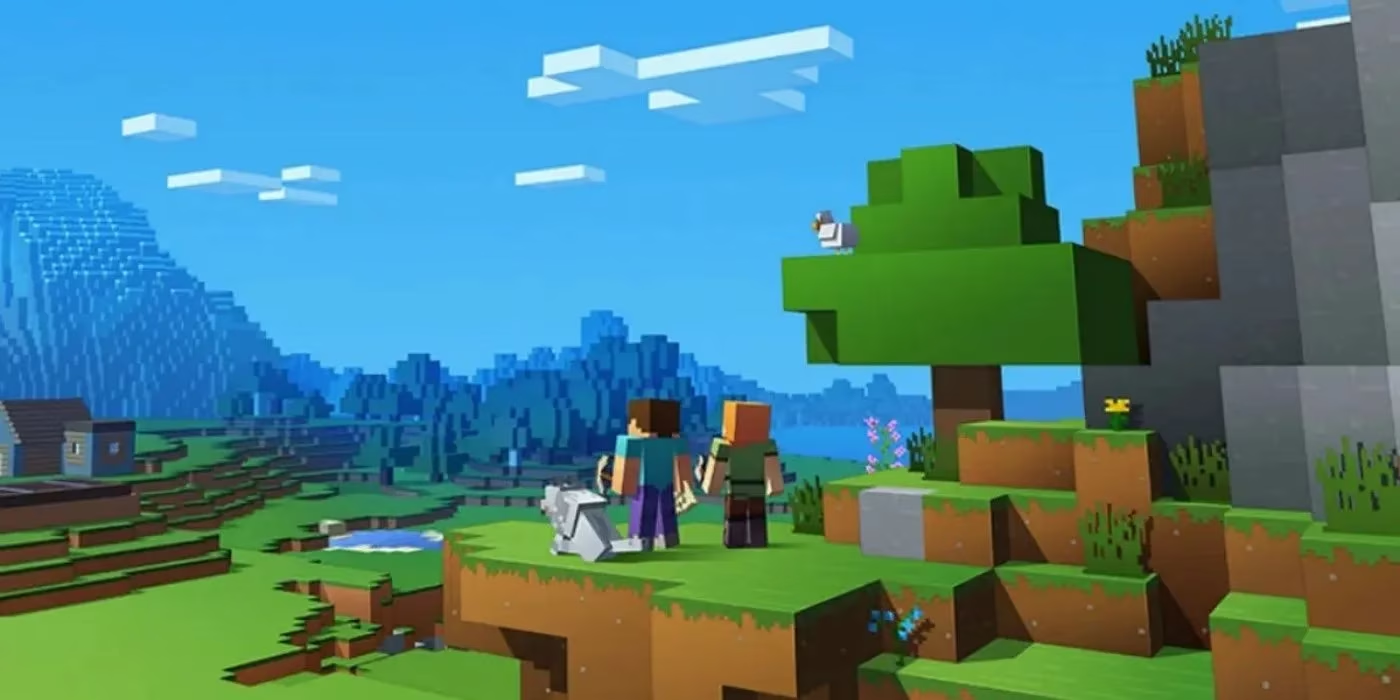
But this monumental New York City build is merely one shining star in a much larger constellation. It represents a single, impressive contribution to an undertaking of almost unimaginable scope: the 'Build The Earth' project. The goal here is as audacious as it is simple: to recreate the entire planet Earth within Minecraft on a true 1:1 scale. Think about that for a moment. Every mountain range, every city street, every forest and coastline—all built block by block to mirror reality as closely as the game's mechanics allow. As of 2026, this colossal collaborative effort has already mapped over 6,700 square kilometers (roughly 2,500 square miles) of our world, with nearly 4,500 individual builds currently in active development by volunteers across the globe.
So, how does such a massive project even function? The 'Build The Earth' initiative operates on a powerful principle: decentralized, community-driven collaboration. It actively recruits builders from every corner of the world, encouraging them to focus on areas they know intimately. Are you from a small town in Italy? You could be the one to craft its piazzas and cobblestone streets. Do you live near a famous national park? Your expertise could bring its unique topography to life. This localized approach ensures authenticity and detail that a single, centralized team could never achieve. The project provides tools and guidelines—often utilizing specialized mods and data packs—to import real-world topographic and geographic data, giving builders an accurate foundation. From there, it's up to human creativity and dedication to populate the landscape with buildings, roads, and vegetation.
This brings me back to the New York City build. What makes it and other top-tier contributions so breathtaking? The secret often lies in the sophisticated toolset beyond vanilla Minecraft.
The Tools Behind the Realism
Modern Minecraft builders, especially those involved in megaprojects, rarely work with just the base game. They employ a suite of enhancements to achieve that near-photorealistic look:
| Tool Category | Purpose & Effect |
|---|---|
| Shader Packs | Dynamically overhaul lighting, shadows, water reflection, and atmospheric effects. They transform flat, static lighting into dynamic sunrises, volumetric fog, and realistic shadows that make builds feel alive. |
| Resource Packs / Mods | Replace default textures with high-resolution, realistic alternatives. Bricks look like bricks, glass has reflections, and metal surfaces gain proper sheen. Some mods add entirely new block types for greater detail. |
| World Editing Tools | Software like WorldEdit allows builders to manipulate thousands of blocks at once—filling large areas, creating complex shapes, and applying patterns—which is essential for projects of this scale. |
| Data Import Utilities | Critical for 'Build The Earth,' these tools convert real-world map and elevation data directly into a Minecraft world format, providing the perfect 1:1 canvas. |
The result? Builds that often require a double-take. We've seen recreations of Vietnam's tallest building that could be mistaken for a photograph, and now, an entire New York City skyline that feels palpably real, even in its blocky form.
The Scale of Ambition: What Does "1:1" Really Mean?
Let's break down the commitment behind a one-to-one scale. In this New York City replica:
-
One Minecraft block = One real-world meter.
-
The Empire State Building, at approximately 443 meters to its tip, would require a tower 443 blocks tall. That's a construction project demanding immense patience and planning.
-
City blocks, avenues, and Central Park's pathways all must adhere to their real-world dimensions. This isn't artistic interpretation; it's digital cartography through construction.
This rigorous standard is what unites all contributions to 'Build The Earth.' It ensures that a street in London correctly connects to a bridge, which then scales accurately to a mountain range in Scotland. The project is essentially building a fully explorable, three-dimensional atlas.
The Future of a Blocky Planet
As a member of this community, I find the implications thrilling and a little dizzying. The 'Build The Earth' project is more than a collection of builds; it's a persistent, evolving monument to global collaboration. Will it ever be "complete"? Realistically, probably not—our planet is vast, and landscapes are constantly changing. But that's almost beside the point. The project's true value lies in the journey and the community it has fostered.
It raises fascinating questions about digital preservation and exploration. Imagine, a decade from now, being able to virtually walk through a meticulously preserved 2026 version of a neighborhood that has since changed, or visit global wonders from your computer. The project democratizes exploration and architectural appreciation in a way nothing else can.
For now, the call to action remains open. The project continues to seek builders, digital cartographers, and dedicated artists. The New York City skyline stands as a towering testament to what's possible. What part of our world will be built next? Perhaps a detailed model of the Swiss Alps, a faithful recreation of Tokyo's Shibuya Crossing, or the winding canals of Amsterdam. The blueprint is our planet itself, and the builders are anyone with passion, patience, and a love for Minecraft. The only limit, it seems, is the Earth itself—and even that is being methodically transformed, one block at a time.
As detailed in SteamDB, community-driven games like Minecraft thrive on long-tail engagement, where ongoing player activity and constant iteration help sustain massive collaborative efforts like Build The Earth—making ambitious 1:1 projects (from a block-accurate New York City skyline to entire regional landscapes) feel less like one-off showcases and more like living worlds that can keep expanding for years.
Comments