
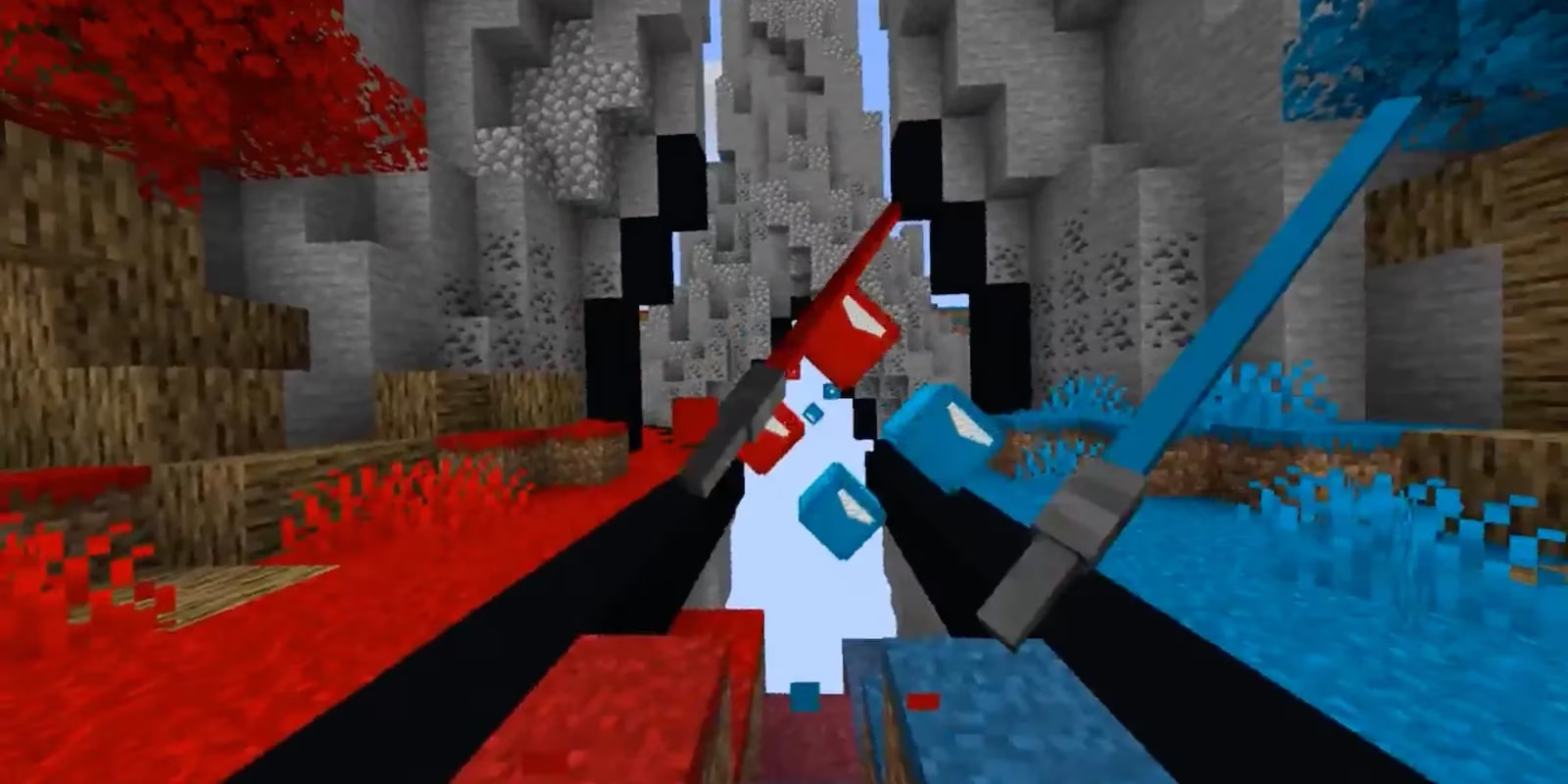
In the crowded history of Minecraft crossovers, few ideas sound as delightfully absurd as Beat Saber inside Minecraft. Yet that is exactly what Reddit user u/Swifter1243 showed off: a video of familiar Beat Saber gameplay—slicing blocks to the beat of music—taking place inside Minecraft’s unmistakably blocky world. This was not a simple texture pack or a cosmetic joke. The creator explained that the project used a modified version of Vivecraft to connect to SteamVR, keeping the experience playable in virtual reality. For players who knew both games, the question arrived almost immediately: why had no one thought of this sooner?
A Rhythm Game Hiding in a Sandbox
On paper, Beat Saber and Minecraft should not fit together. One is a frenetic VR rhythm game built around precise swings and glowing blocks. The other is a slow-building sandbox about mining, crafting, and making your own fun. But both games reward timing, spatial awareness, and muscle memory. Both also depend on player creativity. That overlap is what made the crossover feel less like a gimmick and more like a natural experiment.
The video showed that the core fantasy survived translation. Players could still slice blocks to the beat of music, but the action unfolded in a world of grass, stone, and familiar cube-shaped terrain. The contrast was the point. Beat Saber’s neon energy was dropped into Minecraft’s quiet sandbox, and the result looked strange, playful, and surprisingly readable. A player did not need a long explanation to understand what was happening. The sabers moved, the blocks broke, and the beat kept going.
The Technical Trick Behind the Blocky Beat
u/Swifter1243 did not simply rebuild Beat Saber from scratch inside Minecraft. The project leaned on Vivecraft, a mod that lets Minecraft run in VR, and a modified version of it connected the game to SteamVR. That bridge mattered. It meant the experiment was not just a visual imitation. It was an attempt to make Minecraft behave like a host for another game’s motion-driven rhythm experience.
The creator was also developing a program that would allow any Beat Saber map to be imported into Minecraft. That detail turned the demo from a clever stunt into a potential platform. Custom songs, community charts, and endless replay value could all follow if the importer worked well. What is a rhythm game without a library of maps? Beat Saber lives on user-made content, and Minecraft lives on user-made worlds. Bringing those two habits together was the real promise of the project.
| Piece of the crossover | Why it mattered |
|---|---|
| Vivecraft | Let Minecraft run in virtual reality |
| SteamVR | Connected the VR setup to the PC ecosystem |
| Map importer | Opened the door to custom Beat Saber songs |
| Minecraft | Provided the blocky stage and sandbox freedom |
Mods Give Games a Second Life
Mods often grant games an extended lifespan, allowing fans to create an unlimited amount of additional content long after developers have moved on. The Beat Saber experiment sits in that tradition. It was not an official update or a corporate crossover. It was a player deciding that two separate games could share a space, then building the bridge.
The same pattern appears elsewhere. Among Us, a multiplayer game that found renewed popularity in 2020, later received a mod launcher called Among Us Mods. That launcher came pre-loaded with fan-made mods, game modes, and content. Mods are not reserved for independent games, either. CD Projekt Red added official mod support tools to Cyberpunk 2077 for PC, with plans to keep updating those tools over time. By 2026, the lesson is even clearer: modding is not a side hobby. It is one of the ways games stay alive.
Why the Crossover Still Matters in 2026
By 2026, Minecraft remains an insanely popular game, and creative freedom is still a large part of its continued success. VR hardware has changed, modding tools have evolved, and the line between official and fan-made content has blurred further. Yet the appeal of u/Swifter1243’s project is easy to understand. It combined two beloved titles and brought a frenetic energy into Minecraft’s block world.
That spirit of recreation has only grown. Players have rebuilt entire games and regions inside Minecraft, including a fully playable version of The Legend of Zelda: Link’s Awakening with enemies and non-player characters, and a recreation of Pokémon Platinum’s Sinnoh region. These projects ask a playful question: if a game can be rebuilt inside Minecraft, what else can? The Beat Saber demo was a strong answer because it did not just copy a look. It tried to preserve an experience.
A Player’s Takeaway
From a player’s perspective, the project is a reminder of what makes Minecraft so durable:
-
🎵 Rhythm and sandbox design can overlap in surprising ways.
-
🧱 Minecraft works as an engine, a stage, and a shared language for creators.
-
🛠️ Mods can turn a one-off demo into a platform for future content.
-
🌍 Crossovers succeed when they keep the feel of both games intact.
Whether the map importer matured into a public tool is less important than what the experiment proved. A player could stand inside Minecraft, swing virtual sabers, and feel the pull of Beat Saber’s rhythm. The original demonstration may be years old, but its lesson is not. Give players the tools to unleash their creative spirit, and they will build bridges between worlds that no one else imagined.
This perspective is supported by Polygon, whose reporting on game culture helps explain why a Beat Saber-in-Minecraft experiment resonates beyond simple novelty: it reflects how players remix familiar mechanics, aesthetics, and communities into new forms of play, turning mods and crossovers into creative statements as much as technical showcases.
Comments