
As the highly anticipated release of The Legend of Zelda: Tears of the Kingdom draws near, fans continue to meticulously analyze every piece of promotional material released by Nintendo. 🗺️ With the game's launch on the horizon, the community has been presented with a series of brief 30-second trailers, primarily recut for Japanese media from the third and "final" main trailer. While offering little in the way of brand-new footage, these trailers contain subtle environmental details and character moments that have sparked intense discussion and theory-crafting among the dedicated fanbase. The collective effort to piece together the upcoming story and the altered landscape of Hyrule has become a global pastime, with each frame scrutinized for clues about the fate of Link, Zelda, and the kingdom itself.
🔍 Clues from the Gerudo Wasteland
One of the most intriguing environmental details spotted in the recent trailers is a brief shot of the Gerudo Wasteland. Eagle-eyed observers have noted that only four of the eight iconic Heroine statues are visible in the frame. This is a significant departure from their state in Breath of the Wild, where initially seven statues are part of the "Seven Heroines" Shrine Quest, with the eighth being revealed only after its completion. The apparent absence of three more statues suggests that the calamity unleashed by Ganon has wrought profound and specific changes to the very geography and history of Hyrule. This visual clue implies that the upheaval is not merely superficial but may have erased or altered ancient cultural landmarks, deepening the mystery of what forces are at play in the kingdom's latest crisis.
⚔️ The Mystery of the Master Sword
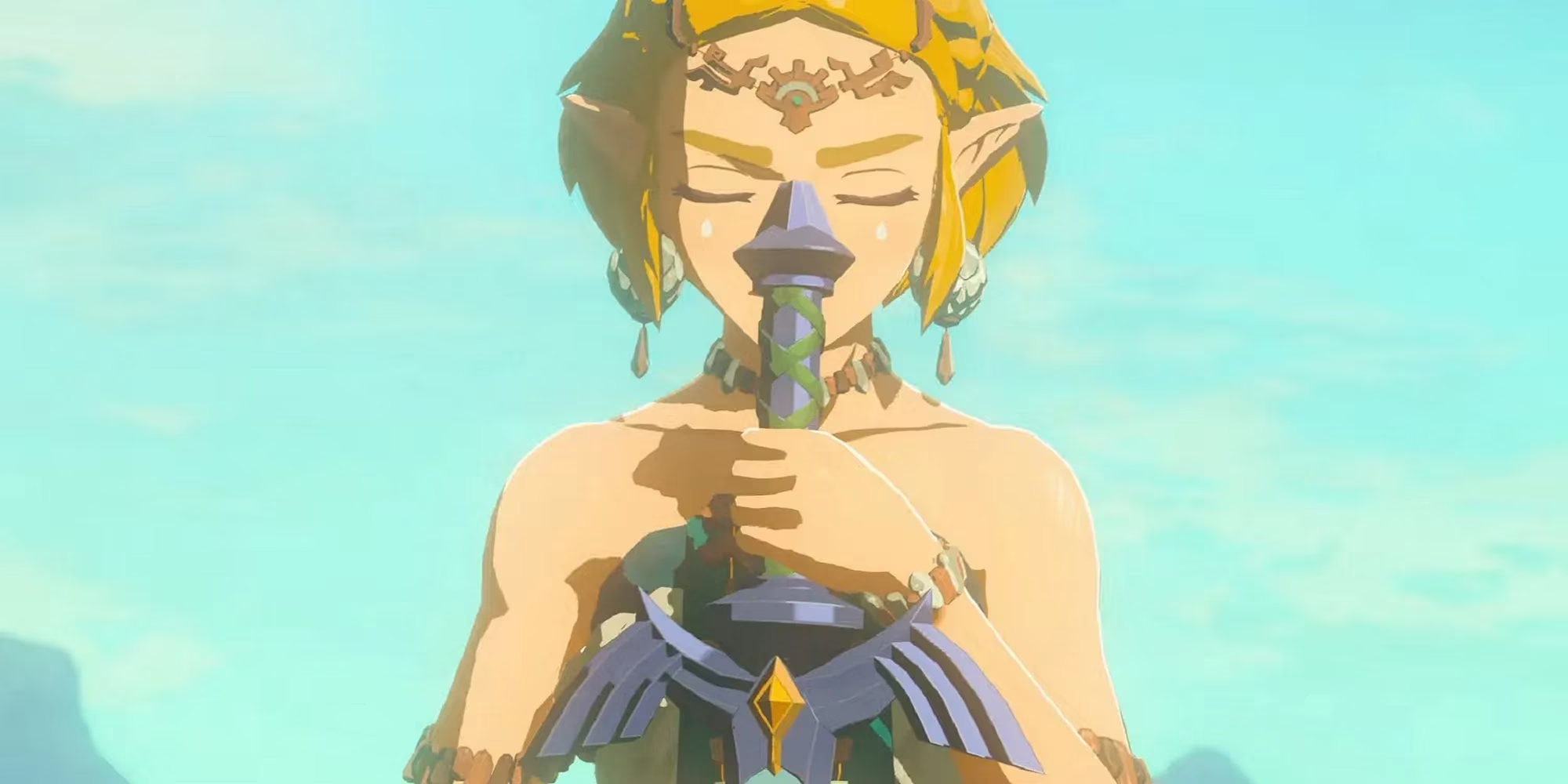
Perhaps the most discussed single image from the promotional material is a shot of Princess Zelda turning to face the sun while holding the visibly damaged Master Sword. This scene has fueled one of the game's central narrative theories. For a while, fans have suspected that the Master Sword becomes damaged by Ganon's corruption, a fact seemingly confirmed in earlier trailers. However, previous shots had shown Zelda holding an uncorrupted version of the blade. This inconsistency has led to a compelling leading theory about the game's time-bending narrative.
It is now widely speculated that Zelda is somehow sent back in time. The proposed mechanism for communication between the past and present is the Master Sword itself. The theory suggests that Zelda, stranded in the ancient past, stays in touch with Link in the present by speaking through the sword—using the undamaged Master Sword of the past as a conduit to communicate with the corrupted blade Link holds. This would create a unique and poignant link between the two heroes across the ages.
| Theory Element | Proposed Explanation |
|---|---|
| Zelda's Displacement | Sent to the past by a failed use of the Recall ability. |
| Communication Method | Speech transmitted through the temporal state of the Master Sword. |
| Narrative Purpose | Allows Zelda to attempt to alter past events to stop Ganon in the present. |
⏳ The Recall Ability Culprit Theory
The question of how Zelda is sent back in time leads to another major fan theory involving Link's new Recall ability. This power, which allows him to reverse the movement of objects through time, is speculated to be involved in the pivotal opening cutscene. In this scene, Link is seen desperately stretching out to a falling Zelda. The prevailing theory posits that Link attempts to use the Recall rune on Zelda to save her, but the power malfunctions or is overwhelmed. Instead of simply reversing her fall, it accidentally catapults her far back into Hyrule's ancient history.
While initially a catastrophic error, this accident could become a strategic boon. Stranded in the past, Zelda would be in a unique position to investigate the origins of the Calamity and potentially alter key historical events to prevent Ganon's rise in her own time. This sets the stage for a dual-narrative, with Link exploring and battling in a devastated present-day Hyrule while Zelda operates as an agent of change in the foundational past.
🏝️ The Origin of the Sky Islands
Beyond the time-travel theories, another major point of speculation concerns the stunning floating sky islands where Link begins his new journey. A compelling theory suggests these islands are not originally from Hyrule's skies. Long-time series fans have noted that their aesthetic and design bear a striking resemblance to artistic depictions of the Sacred Realm from A Link to the Past. This visual similarity hints that the islands may represent a divine or separate realm that has become accessible due to Hyrule's upheaval.
The potential implications are vast:
-
Divine Sanctuary: The islands could serve as a safe haven created or provided by the gods (like Hylia) to protect Link and give him a base of operations.
-
Ancient Civilization: They might be the remnants of an advanced ancient civilization, such as the Zonai, whose technology is now reactivated.
-
New Dungeon Format: Each major island could function as a replacement for or evolution of the traditional Divine Beast dungeons, offering large, complex, multi-level challenges.
This theory adds a layer of mythological depth, suggesting Link and Zelda may receive direct assistance from higher powers in their fight, or that they are tapping into forgotten realms of power.
🤔 The Bigger Picture
As launch day approaches, these theories paint a picture of a game with immense narrative ambition. Tears of the Kingdom appears to be building on the open-world foundation of its predecessor by adding complex layers of time manipulation and dual-world exploration. The potential for a story that intertwines two timelines—Link's actions in the present affecting the world Zelda is trying to shape in the past, and vice-versa—promises a level of narrative depth rarely seen in the series.
The environmental storytelling, hinted at by changes like the missing Gerudo statues, suggests a world that is not just expanded vertically but dynamically altered by the core conflict. The game seems poised to explore themes of legacy, sacrifice, and the cyclical nature of history, all while giving players unprecedented freedom in a broken yet beautiful world. While the trailers have provided tantalizing clues, the full truth of Zelda's fate, the origin of the sky islands, and the ultimate power of the Master Sword will finally be revealed when the game launches. The decade-long wait is almost over, and Hyrule's next chapter promises to be its most mysterious and epic yet. 🛡️✨
Comments